Wednesday, October 10, 2012

studying technique

 
                    Studying does not end after schooling, studying is a part of
                    the routine of people who aim to be successful in everything
                    they do.But this doesn't mean you have to burden yourself
                      in memorizing the facts that you need.There are studying
                           techniques which would make studying easier,
                                      one of those is MNEMONICS 


Acronyms is an example of a mnemonic strategy.An acronym is made by abbreviating the first letters of  the words to be remembered. Examples:


You just have to think of the word RAP in remembering those three tips in reading


to remember a phrase you can just remember a word


This is a famous acronym of the colors of the rainbow


Try  Mnemonic as a study technique! 


Find out more 

at

Lakeside International Academy


Tuesday, September 18, 2012

Subject and Verb Agreement

           A good sentence has a verb that "agrees" with the subject. There are many rules yet the main point is that, if the subject is singular, the verb must also be singular in form.

*A singular verb usually ends in -s
RULE 1: Miyu shares her food to the beggar.  (Miyu-the subject is singular)
   Miyu and Raiku share their food to the beggar. (The subjects are plural)

Other examples:
She loves to eat  bananas
They love to eat bananas

*But remember! The pronouns, "I "and "You"  take a plural verb.

I like the doll  not I likes the doll
You are beautiful not you is beautiful.

* The Pronoun "I' is also usually paired with the linking verb "am" not "is"

I am good in English not I is good in English.

Now Can you tell if the verb agrees with the subject in these sentences?

1. Ping hate walking in the rain.
2. The girl beside the basket of flowers looks unhappy.
3. Is you looking for this dog?
4.Everybody is talking.
5. The news are unbelievable.


        Find out the answers
 at 
       www.lsiacademy.com


Saturday, September 1, 2012

Job interview tips

JOB INTERVIEW TIPS


There are a lot of jobless people right now and hunting for a job 
becomes a challenging task. Passing a job interview gives one the passport
to a job.Thus, one must do his/her best , imagine that you are one
 of the tigers who are competing for one meat.


Here are some tips :
1.Look your best : Wear a descent attire and groom well. Personality can be first seen on how you look. 

2.Observe proper manners: It would be a point not to sit down unless being told by the interviewer,sit properly when you are asked to be seated. 

3.Answer briefly: Be straight to the point. More words, more mistakes

4.Be confident: Feeling nervous is natural, you can't avoid being nervous but you can control and hide it. 

5. Look smart and think smart: Answer the questions in a loud and clear voice,be lively and don't show hesitations.


Want more of these tips?


Join our competitive students 
at
www.lsiacademy.com


Tuesday, August 28, 2012

business English idioms

Doing business interests many people today. The world of business is full of challenges and businessmen usually encounters tough situations. A lot of idiomatic expressions are commonly used to better express an emotion and to influence listeners. Familiarize yourself to these expressions and get ready to apply these in business situations.


1. Put your cards on the table (be completely honest)

I can't find of other convincing reasons as I presented our plan, I had no choice but to put my cards on the table and asked them to aid us in gaining funds for the project.

2.an old hand (experienced person )

We must go for plan B, trust me because I am an old hand to this business and I had already experienced the same situation.

3.belt-tightening (minimize expenses)

We had to do some belt-tightening until we had gain a profit.

4. bite the bullet(make a painful decision)

The manager had made a grave offense and so the company had to bite the bullet and terminate him

5.11th hour(last minute)

The staff had lots of work to do and so they have to work hard until the 11th hour of their working time.


Can you make your own sentence ?


What appears common may appear new to you, don't be left behind, because in business you must have a quick mind!

Learn fast !
Visit www.lsiacademy.com


Wednesday, June 13, 2012

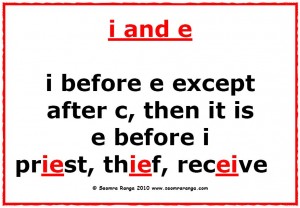
Spelling: 'i' before 'e' except after 'c'


Spelling matters. If you want to create a good impression in your writing and make sure you get your meaning across clearly, it’s important to get your spelling right.


i before e except after c

Most people know the spelling rule about i before e except after c, as in the following words:
-ie-
-ei-
achieve
ceiling
belief
conceit
believe
deceit
chief
deceive
piece
perceive
thief
receipt
yield
receive
 
The rule only applies when the sound represented is ‘ee’, though. It doesn’t apply to words like science or efficient, in which the –ie- combination does follow the letter c but isn’t pronounced ‘ee’.
 
There are a few exceptions to the general i before e rule, even when the sound is ‘ee’. Examples include seize, weird, andcaffeine. There’s nothing for it but to learn how to spell these words, checking in a dictionary until you are sure about them.


Enjoy learning English here
at

Thursday, June 7, 2012

Dangling Participles


Dangling participles


Participles of verbs are often used to introduce subordinate clauses, which give extra information about the main part of a sentence (known as the main clause). It’s important to use participles in subordinate clauses correctly. The participle should always describe an action performed by the subject of the main part of the sentence. 

For example:
 
Mrs Stevens,
opening the door quietly,
came into the room.
[subject]
[participle]
 
In this sentence, the present participle (opening) in the subordinate clause refers to the subject of the main clause. Mrs Stevens is both opening the door and coming into the room.
 

Sometimes writers forget this rule and begin a sentence with a participle that doesn’t refer to the subject of their sentence. They then end up with what’s known as a dangling participle, as in this grammatically incorrect statement: 

 
Travelling to Finland,
the weather got colder and colder.
[participle]
[subject]
 
Strictly speaking, this sentence means that it is ‘the weather’ that is ‘travelling to Finland’, which obviously isn’t what the writer was intending to say. The sentence needs to be reworded to make the meaning clear and to make it grammatically correct, e.g.:

 
As I was travelling to Finland, the weather got colder and colder.
or:
 
Travelling to Finland, I found that the weather got colder and colder.


visit our website: http://www.lsiacademy.com/

Tuesday, June 5, 2012

Different from,than or to


Different from, than, or to

Is there any difference between the expressions different from, different than, and different to? Is one of the three ‘more correct’ than the others?

In practice, different from is by far the most common of the three, in both British and American English:
 
We want to demonstrate that this government is different from previous governments. (British English)

This part is totally different from anything else that he's done. (American English)
 
Different than is mainly used in American English:
 
Teenagers certainly want to look different than their parents.


Different to is much more common in British English than American English:
 
In this respect the Royal Academy is no different to any other major museum. 


Enjoy learning English here
at