Tuesday, August 13, 2013
Friday, July 5, 2013
Interjection
Can you determine the interjection in the following sentences? Give it a try!
1. Oh! the baby is falling!
2. Mom allowed me to go camping with my friends .Yipee!
3. Ouch! You stepped into my foot!
Interjections are short exclamations, we often used it in speaking to express our emotion. If your answers are "Oh!", "Yipee" and "Ouch!" then I should say this interjection.. HURRAY!
Interjections are easy to determine in the sentence, yet you must familiarize yourself on its usage. There are interjections used to express agreement, pain, excitement and many more.
Find out all of these and express yourself freely!
at
Lakeside International Academy
www.lsiacademy.com
Monday, June 10, 2013
Adverb
another part of speech that you should be familiar with
Find out the meaning of adverb by examining the following examples:
1.The robber entered the house secretly. (modify the word "entered" which is a verb)
2.She rode in an extremely fast train. (modify the word "fast" which is an adjective)
3.The athlete jumped incredibly high. (modify the word "high" which is an adverb)
Of course you had to understand the meaning of modify first.
Modify means to change or alter the meaning a certain word.
Modifying a word gives another impression or impact to the reader.
Adverb is a modifying word.
It modifies a verb, an adjective or another adverb.
You should know that not all adverbs are ending in -ly. Just like in the example:
*She ran very fast when she heard the bell.
Very modifies the word fast, but it doesn't end in -ly.
Find out the meaning of adverb by examining the following examples:
1.The robber entered the house secretly. (modify the word "entered" which is a verb)
2.She rode in an extremely fast train. (modify the word "fast" which is an adjective)
3.The athlete jumped incredibly high. (modify the word "high" which is an adverb)
Of course you had to understand the meaning of modify first.
Modify means to change or alter the meaning a certain word.
Modifying a word gives another impression or impact to the reader.
Adverb is a modifying word.
It modifies a verb, an adjective or another adverb.
You should know that not all adverbs are ending in -ly. Just like in the example:
*She ran very fast when she heard the bell.
Very modifies the word fast, but it doesn't end in -ly.
Needs further explanation?
Listen to our Filipino Tutors online!
visit www.lsiacademy.com
Wednesday, February 20, 2013
Adjectives
Examine the following sentences:
Sentence 1:I saw a bird on the tree.
Sentence 2:I saw a fat, young , red bird resting on the frail branches of a dying oak tree.
which sentence is more appealing to you?
which sentence creates a clear visual on your mind?
If you say it's sentence 2, what words help you visualize what the speaker is talking about?
*The words: fat, young, red, frail, dying and oak are called Adjectives.
Adjectives are describing words.
*Adjectives create a visual effect on the reader as if he or she actually saw what was described.
*Adjectives not only creates a visual effect but also brings emotion to the reader.
*Famous writers such as Shakespeare pour a wide range of adjectives into their scripts and these describing words are the ones touching the reader and making him or her feel like he is present on the scenes.
Let's Practice: Insert adjectives on this sentence to make it more appealing to the reader.
The boy is looking at the sky.
Practice more of these with our online tutors!
visit www.lsiacademy.com
Monday, February 18, 2013
Abbreviations Vs. Contractions
Abbreviations: Contractions
Can you spot the difference?
Abbreviations and contractions are both shortened forms of words but here are their differences:
1. Punctuation marks
2.Pronunciation
3. Formality
- Mr. *can't
- Mrs. *shouldn't
- Prof. *isn't
Can you spot the difference?
Abbreviations and contractions are both shortened forms of words but here are their differences:
1. Punctuation marks
Abbreviations makes use of a "period" ( . ) at the end while contractions do not. They make use of an "apostrophe" ( ' ) to replace the omitted letter of a word instead.
2.Pronunciation
An abbreviated word does not have a distinct pronunciation on the original word. For example, Mr. is the abbreviated word for Mister. You read both Mr. and Mister the same way. Whereas, a contracted word is pronounced differently from its original word.
3. Formality
Most Abbreviations are not accepted in formal writing, such as "Jan. (abbreviated word of January). In most cases, abbreviated titles of professions are the only allowed abbreviations in formal write ups.
Whereas, using contractions are accepted, only that they are bounded by some usage rules in grammar.
Spot the difference between commonly confused words in English
at
Lakeside International Academy
Wednesday, February 6, 2013
Answering Negative questions
Negative questions can somehow be tricky. You must always remember that:
"Yes" is a positive answer "No" is a negative answer
Positive questions Negative questions
Are you going to school tomorrow? Aren't you going to school tomorrow?
Did you finish your homework? Didn't you finish your homework?
Is she going to the party? Isn't she going to the party?
Note that,the positive and negative questions in the examples has the same idea.The only difference is that, the questions on the right are asked in a negative way to emphasize something or to express a different emotion.The questions should not change the answer.
Question: Do you know Mr.Kito? Question: Don't you know Mr.Kito?
Answer : Yes, I do. Answer : Yes, I do
Question: Should I take this? Question: Shouldn't I take this?
Answer : No, you shouldn't. Answer :No, you shouldn't
Are you know confident to answer Negative questions?
Learn the easiest way
at
Lakeside International Academy
Monday, November 26, 2012
Positive and Negative Sentence
Determine the difference between these Sentences
Sentence A Sentence B
I can read fluently. I can't read fluently.
She has a guitar. She doesn't have a guitar.
They have questions. They don't have questions.
He is reading. He isn't reading.
The ducks are afraid. The ducks aren't afraid.
Can you tell which of the group of sentences is positive and negative?
Positive sentences are statements that tells about facts.
Negative sentences are also statements but it tells that an idea is not true. The easiest way to identify a negative sentence is the presence of the word "no" and "not".
Now go back to the groups of sentences and recognize the positive and negative sentences!
But of course! You must remember that not all negative sentence has the word "no" or "not". There are other words that have a negative meaning.
Know those words at Lakeside International Academy!
Thursday, November 8, 2012
English Grammar
GRAMMAR is a set of rules that make up a language.
Grammar is important in English, since it serves as a guide in using the language as a means of communication and understanding how words, phrases, sentences and paragraphs should be formed.
English Grammar started to develop during the 16th century.The book entitled "Pamphlet for Grammar which was written by William Bullokar made a remarkable imprint during the said century.
During the first half of the 19th century, 900 books talking about the significance of grammar in the English language were published. As time passed by, Grammar changed as new authors influenced it through writings. Later on, Grammar had been an issue to schools. People began to study grammar.
Today's grammar were modernized. It's now far more different from Grammar that was taught to schools centuries ago as more words and expressions were accepted in the English language.
We were lucky to enjoy the simpler illustrations of English Grammar today as a fruit of numerous people who contributed to its development.
Know More English Facts
at
Lakeside International Academy
Wednesday, October 10, 2012
studying technique
Studying does not end after schooling, studying is a part of
the routine of people who aim to be successful in everything
they do.But this doesn't mean you have to burden yourself
in memorizing the facts that you need.There are studying
techniques which would make studying easier,
one of those is MNEMONICS
Acronyms is an example of a mnemonic strategy.An acronym is made by abbreviating the first letters of the words to be remembered. Examples:
the routine of people who aim to be successful in everything
they do.But this doesn't mean you have to burden yourself
in memorizing the facts that you need.There are studying
techniques which would make studying easier,
one of those is MNEMONICS
Acronyms is an example of a mnemonic strategy.An acronym is made by abbreviating the first letters of the words to be remembered. Examples:
You just have to think of the word RAP in remembering those three tips in reading
to remember a phrase you can just remember a word
This is a famous acronym of the colors of the rainbow
Try Mnemonic as a study technique!
Find out more
at
Lakeside International Academy
Tuesday, September 18, 2012
Subject and Verb Agreement
A good sentence has a verb that "agrees" with the subject. There are many rules yet the main point is that, if the subject is singular, the verb must also be singular in form.
*A singular verb usually ends in -s
RULE 1: Miyu shares her food to the beggar. (Miyu-the subject is singular)
Miyu and Raiku share their food to the beggar. (The subjects are plural)
Other examples:
She loves to eat bananas
They love to eat bananas
*But remember! The pronouns, "I "and "You" take a plural verb.
I like the doll not I likes the doll
You are beautiful not you is beautiful.
* The Pronoun "I' is also usually paired with the linking verb "am" not "is"
I am good in English not I is good in English.
Now Can you tell if the verb agrees with the subject in these sentences?
1. Ping hate walking in the rain.
2. The girl beside the basket of flowers looks unhappy.
3. Is you looking for this dog?
4.Everybody is talking.
5. The news are unbelievable.
Find out the answers
at
www.lsiacademy.com
Saturday, September 1, 2012
Job interview tips
JOB INTERVIEW TIPS
There are a lot of jobless people right now and hunting for a job
becomes a challenging task. Passing a job interview gives one the passport
to a job.Thus, one must do his/her best , imagine that you are one
of the tigers who are competing for one meat.
Here are some tips :
1.Look your best : Wear a descent attire and groom well. Personality can be first seen on how you look.
2.Observe proper manners: It would be a point not to sit down unless being told by the interviewer,sit properly when you are asked to be seated.
3.Answer briefly: Be straight to the point. More words, more mistakes
4.Be confident: Feeling nervous is natural, you can't avoid being nervous but you can control and hide it.
5. Look smart and think smart: Answer the questions in a loud and clear voice,be lively and don't show hesitations.
Want more of these tips?
Join our competitive students
at
www.lsiacademy.com
Tuesday, August 28, 2012
business English idioms
Doing business interests many people today. The world of business is full of challenges and businessmen usually encounters tough situations. A lot of idiomatic expressions are commonly used to better express an emotion and to influence listeners. Familiarize yourself to these expressions and get ready to apply these in business situations.
1. Put your cards on the table (be completely honest)
I can't find of other convincing reasons as I presented our plan, I had no choice but to put my cards on the table and asked them to aid us in gaining funds for the project.
2.an old hand (experienced person )
We must go for plan B, trust me because I am an old hand to this business and I had already experienced the same situation.
3.belt-tightening (minimize expenses)
We had to do some belt-tightening until we had gain a profit.
4. bite the bullet(make a painful decision)
The manager had made a grave offense and so the company had to bite the bullet and terminate him
5.11th hour(last minute)
The staff had lots of work to do and so they have to work hard until the 11th hour of their working time.
Can you make your own sentence ?
What appears common may appear new to you, don't be left behind, because in business you must have a quick mind!
Learn fast !
Visit www.lsiacademy.com
Wednesday, June 13, 2012
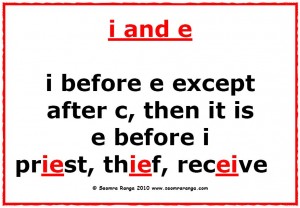
Spelling: 'i' before 'e' except after 'c'
Spelling matters. If you want to create a good impression in your writing and make sure you get your meaning across clearly, it’s important to get your spelling right.
i before e except after c
Most people know the spelling rule about i before e except after c, as in the following words:
-ie-
|
-ei-
|
achieve
|
ceiling
|
belief
|
conceit
|
believe
|
deceit
|
chief
|
deceive
|
piece
|
perceive
|
thief
|
receipt
|
yield
|
receive
|
The rule only applies when the sound represented is ‘ee’, though. It doesn’t apply to words like science or efficient, in which the –ie- combination does follow the letter c but isn’t pronounced ‘ee’.
There are a few exceptions to the general i before e rule, even when the sound is ‘ee’. Examples include seize, weird, andcaffeine. There’s nothing for it but to learn how to spell these words, checking in a dictionary until you are sure about them.
Enjoy learning English here
at
Subscribe to:
Posts (Atom)